
Physician-Led Medical Weight Loss + Coaching — An Honest Memphis Coach’s Take (No Hype)
You’ve heard about the medication. You’ve seen the clinics on every corner. Here’s the honest, non-hyped truth about how it actually works when it’s combined with real coaching — and when it’s the wrong call.
By Rob Yahn — USAW-certified coach, CrossFit L2 Trainer, KMG Instructor (Combat Fight + Third Party Protection), Memphis firefighter, and owner of Fit 901 — Memphis, TN. Last updated April 23, 2026.
If you’re a woman in Memphis and you’ve been on the internet at all in the last two years, you’ve heard about it.
The injectable medications. The medical weight loss clinics. The before-and-after photos. The friend who lost 40 pounds. The other friend who gained it back. The headlines about side effects. The TikToks. The doctors. The pop-up clinics charging anywhere from $200 to $1,500 a month. The conflicting information from everyone who has an opinion (which is everyone).
You’re a smart woman. You’re not looking for a magic shortcut. You’re also not looking to be talked out of something that might actually help your body do what willpower alone hasn’t. You want the honest read.
So here it is — from a coach, not a salesman, not a clinic owner trying to fill chairs.
What The Medication Actually Does (In Plain English)
The current generation of physician-prescribed weight loss medications — the class known as GLP-1 receptor agonists (semaglutide, tirzepatide, and related molecules you’ve seen in the news) — work primarily by:
- Slowing down how fast your stomach empties (so you feel full longer)
- Affecting hunger signals in your brain (so you stop thinking about food constantly)
- Helping your body regulate insulin and blood sugar (which has downstream effects on fat storage)
For a lot of women — especially women over 35, women with hormonal shifts, women with insulin resistance, women whose bodies have been "stuck" for years no matter what they tried — this can be genuinely useful. It’s biology, not magic.
For other women, it’s the wrong tool. Some people don’t need it. Some people’s bodies don’t tolerate it well. Some people’s life situations make it a poor fit.
A real physician should tell you which group you’re in. A clinic that just says "yes" to everyone with a pulse and a credit card is not actually being honest with you.
The Problem With Standalone Injection Clinics
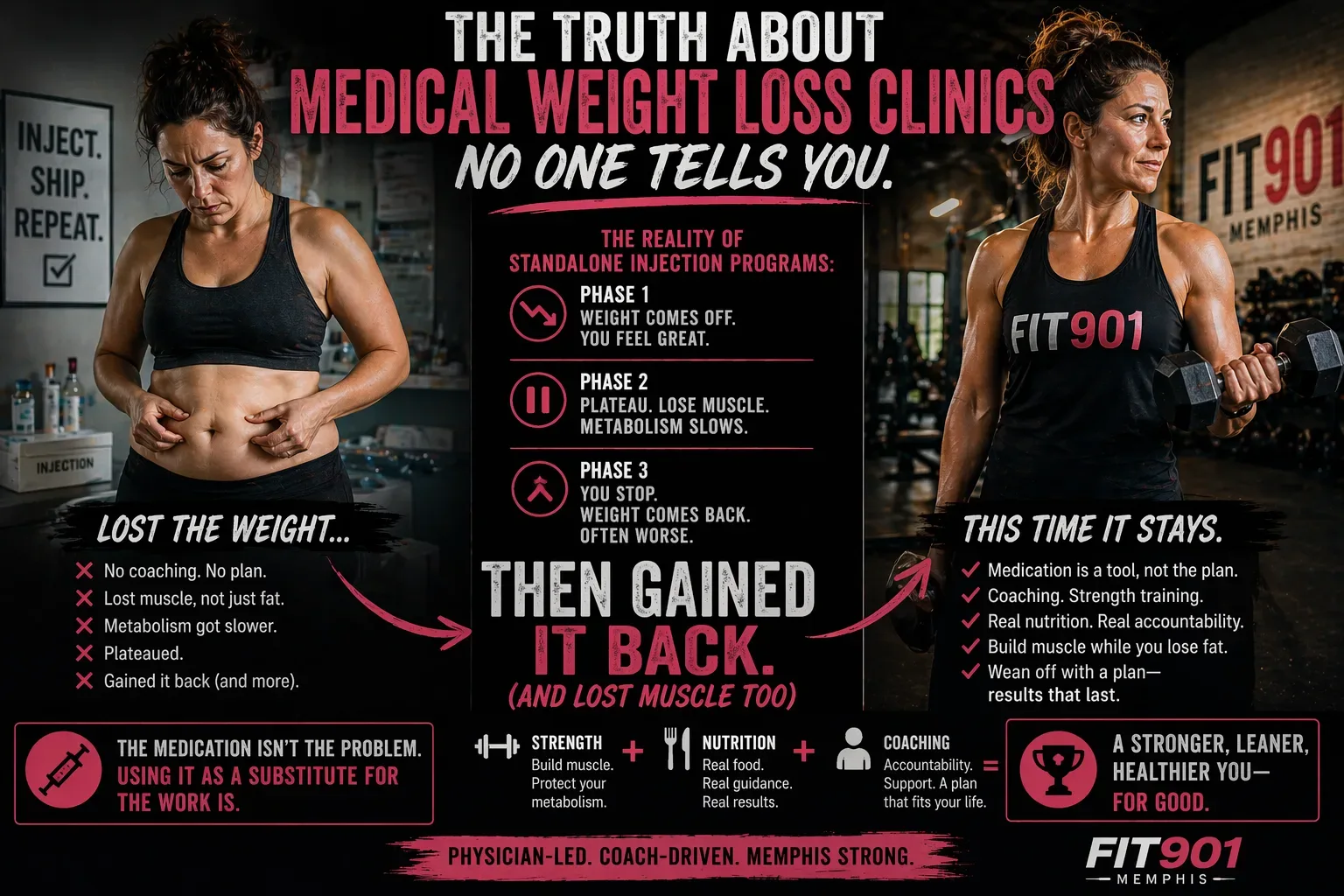
The hype cycle around these medications has produced a wave of clinics whose entire business model is: prescribe medication, ship medication, take payment monthly, repeat. No coaching. No nutrition guidance. No movement plan. No accountability. Just the shot.
Here’s what happens with that model — over and over and over again:
Phase 1 (months 1-6): Weight comes off. You feel great. You tell your friends.
Phase 2 (months 6-12): Weight loss plateaus. You’re eating less but you’ve lost some muscle mass too because you weren’t strength training. Your metabolism is now slower than it was before you started.
Phase 3 (after stopping): Without coaching, without habits built, without a strength foundation, your body returns to roughly where it started — sometimes worse, because you have less muscle and a slower metabolism than you began with.
This isn’t a hypothetical. The data on standalone injection programs without lifestyle change is now well-documented: most of the weight comes back when the medication stops, and the body is in worse metabolic shape than it started.
The medication isn’t the problem. Using the medication as a substitute for the underlying work is the problem.
What "Coaching + Medication" Actually Means (And Why It’s Different)
The way it should work — the way we do it at Fit 901 — is the medication is a layer on top of real coaching, not a replacement for it.
Here’s the difference in practice:
You’re already doing the work. You’re showing up to coached sessions 2-3 times a week. You’re building strength. You’re building habits. You’re tracking nutrition with a real coach (not an app). You have a plan that fits your life.
The medication accelerates what’s already happening. It quiets the constant food noise so the nutrition habits you’re building can actually take hold. It helps your body unstick when biology has been working against you. It buys your willpower a fighting chance.
You’re building muscle and habits while you lose fat. This is the critical piece. When the medication eventually comes off (and the goal is always to wean off, not to be on it forever), the muscle you built, the habits you built, and the strength you built are still there. You don’t crash back to where you started, because the underlying body has actually changed.
A physician supervises the medical side. Real bloodwork. Real check-ins. Real adjustments. Not a chatbot prescription mill.
That’s the offer. Coaching that builds the foundation, medication that helps the body cooperate while the foundation is being built, physician oversight on the medical side, and a real plan to wean off the medication when your body is ready.
Who This Is Actually Right For
Honestly? Not every woman.
It tends to be the right call for:
- Women whose bodies have been genuinely stuck for years despite real effort
- Women with insulin resistance, pre-diabetes, or significant hormonal shifts
- Women with a meaningful amount of weight to lose where diet and exercise alone have plateaued
- Women who are willing to do the coaching work, not looking for a shortcut
It’s the wrong call for:
- Women looking to lose 10 pounds before a wedding
- Women who aren’t going to do the coaching part
- Women whose bodies and habits would respond fine to just structured training and nutrition
- Women whose lives don’t have room for the regular coaching commitment
We tell you honestly on the callback which group you’re in. If your body and life don’t actually need the medication, we’ll tell you that. We’re not trying to upsell every prospect into the most expensive option — we’re trying to match you to what works.
What This Looks Like For The Right Woman
Picture a 42-year-old Memphis woman, two kids, a job, a mortgage, the whole life. She’s tried everything for the last decade. Apps, programs, plans. Lost 10 pounds, gained back 15. Lost 15, gained back 20. Her body has dug itself into a hormonal hole that no amount of "eat less, move more" is climbing out of.
She requests a callback. A coach calls her back. We listen. We look at the situation honestly.
The plan we build for her looks like:
- Three small-group coached sessions a week (real human, real schedule, real accountability)
- A nutrition plan built around her actual life — not an app, a coach
- Habit tracking and weekly check-ins
- A physician layer to help her body unstick — supervised, real bloodwork, real adjustments
- A structured wean-off plan when her body has built the foundation to hold the change on its own
- Continued membership after the initial program for the maintenance phase
That’s what an honest combined offer looks like. No hype. No "rapid results." No "lose 30 pounds in 30 days." Real coaching, real medical oversight, a real plan to get the medication out of the picture once the body has changed underneath.
For the broader picture of why women in this position have been quietly stuck for years — and what’s actually at stake beyond the weight — the evergreen pillar on feeling like yourself again is the long-form read. If a Mother’s Day angle is on the table, the Mother’s Day pillar is written for that.
Frequently Asked Questions
Is medical weight loss with coaching right for women over 40 in Memphis?
It can be, but not for every woman. The combined approach works best for women whose bodies have plateaued despite real effort — typically because of hormonal shifts, insulin resistance, or years of yo-yo dieting that’s wrecked the metabolism. It’s the wrong call for women looking to lose 10 pounds for a wedding, or for women who aren’t willing to do the coaching part. The callback is where we figure that out honestly.
How long do women usually stay on the medication?
The goal is always to wean off, not to stay on forever. A typical arc is 6-18 months on the medication while the real coaching work — strength training, nutrition habits, accountability — catches up underneath. Once the muscle is built, the habits are sticky, and the body has shifted, the medication comes off. Standalone injection clinics rarely have this plan. A real coaching + medical partnership does.
What’s the difference between Fit 901’s approach and the injection clinics around Memphis?
The injection clinics prescribe the medication, ship it monthly, and take your credit card. That’s the whole program. At Fit 901, the medication is optional and only when it’s the right call — and it’s layered on top of real coaching: 2-3 coached sessions a week, nutrition planning with a human coach (not an app), weekly check-ins, and a wean-off plan. The medication is a tool. The coaching is the program.
What if I don’t actually need the medication — will you tell me?
Yes. On the callback we’ll tell you honestly which group you’re in. Some women’s bodies and situations respond fine to structured training and nutrition alone. We’d rather match you to what works than upsell you into the most expensive option — that’s not how we operate.
How much does the combined coaching + medical weight loss program cost in Memphis?
It depends on your situation, your program length, and whether medication is part of the plan. We talk through pricing honestly on the callback — after we’ve heard your situation and know whether we’re the right fit for each other. No surprise fees, no bait-and-switch, no "call for a quote" runaround. A real conversation.
The Honest Bottom Line
Physician-led medical weight loss is a real tool. It works for the right person, with the right coaching wrapped around it, with the right plan to wean off when the body has caught up.
It is not a shortcut. It is not a substitute for the underlying work. It is not the right call for everyone.
If you want a clinic that sells you the shot and waves goodbye, there are dozens of them in Memphis. We’re not one of them.
If you want an honest conversation about whether the combined approach is right for your body, your life, and your goals — that’s what the callback is for.
Ready to start?
Request a callback — we’ll talk through honestly whether the combined coaching + medical approach is right for your body, or whether coaching alone is the better call. No hype, no pressure. We call within 24 hours from 901-657-4552.
Save 901-657-4552 to your contacts now. If you don’t, our call can get screened as spam and you’ll miss us.
About Fit 901
We’re a Memphis coaching gym built around the idea that real coaching beats every shortcut on the market. Small-group coaching, real plans, optional physician-led medical weight loss for clients whose bodies need that layer (with a clear plan to wean off, not stay on forever). Every member has a coach who knows her name and her week.
Owned and coached by Rob Yahn — Memphis firefighter, USAW-certified coach, CrossFit L2 Trainer, KMG Instructor (Combat Fight + Third Party Protection), and a guy who’d rather tell you the truth about whether something is right for you than sell you something you don’t need.
Ready to start?
Request a callback — we’ll talk through honestly whether the combined approach is right for you. No hype, no pressure. We call within 24 hours from 901-657-4552.
Save 901-657-4552 to your contacts now. If you don’t, our call can get screened as spam and you’ll miss us.
Ready to See What’s Possible?
Whether you’re starting with our 9-week transformation, joining a CrossFit class, or beginning physician-led medical weight loss, the path begins the same way: a real conversation with our team.
Tell us where you are and where you want to be — we’ll personally call you within 24 hours to talk through which Fit 901 path fits your goals.
About the Author
Rob Yahn is the owner and head coach of Fit 901 in Memphis. A 32-year firefighter and paramedic, USAW-certified weightlifting coach, and CrossFit Level 2 Trainer, Rob has spent over two decades coaching real Memphians through real transformations. Save 901-657-4552 in your phone — that’s the Fit 901 line.