
Alex was in a hospital bed after a massive stroke. The doctors did not expect him to recover. They told his family he might never work again, might never walk again — and that riding a bike or running was not a conversation worth having.
He is now doing all three.
Where he started
Before Fit 901, Alex was not a runner or a cyclist. He had been active when he was younger, but that was a while ago and a stroke had happened in between. He arrived without a training background to fall back on, which is worth saying plainly, because the version of this story where someone “gets back into it” is a much easier story than the one Alex actually had.
The first sixty days
In his first 60 days of training he lost more than 25 pounds and over 6% body fat. By 120 days he was down roughly 30 pounds.
Those are the numbers, and the numbers are the least interesting part.
What actually changed
The change Alex talks about is not on a scale. It is that he stopped coming home and sleeping the day away.
He rides now. Not “again” — cycling is something he had always wanted to do and never had, and he is building toward real distances. He runs. He has energy for the parts of his life that are not training, which is the entire reason anybody trains.
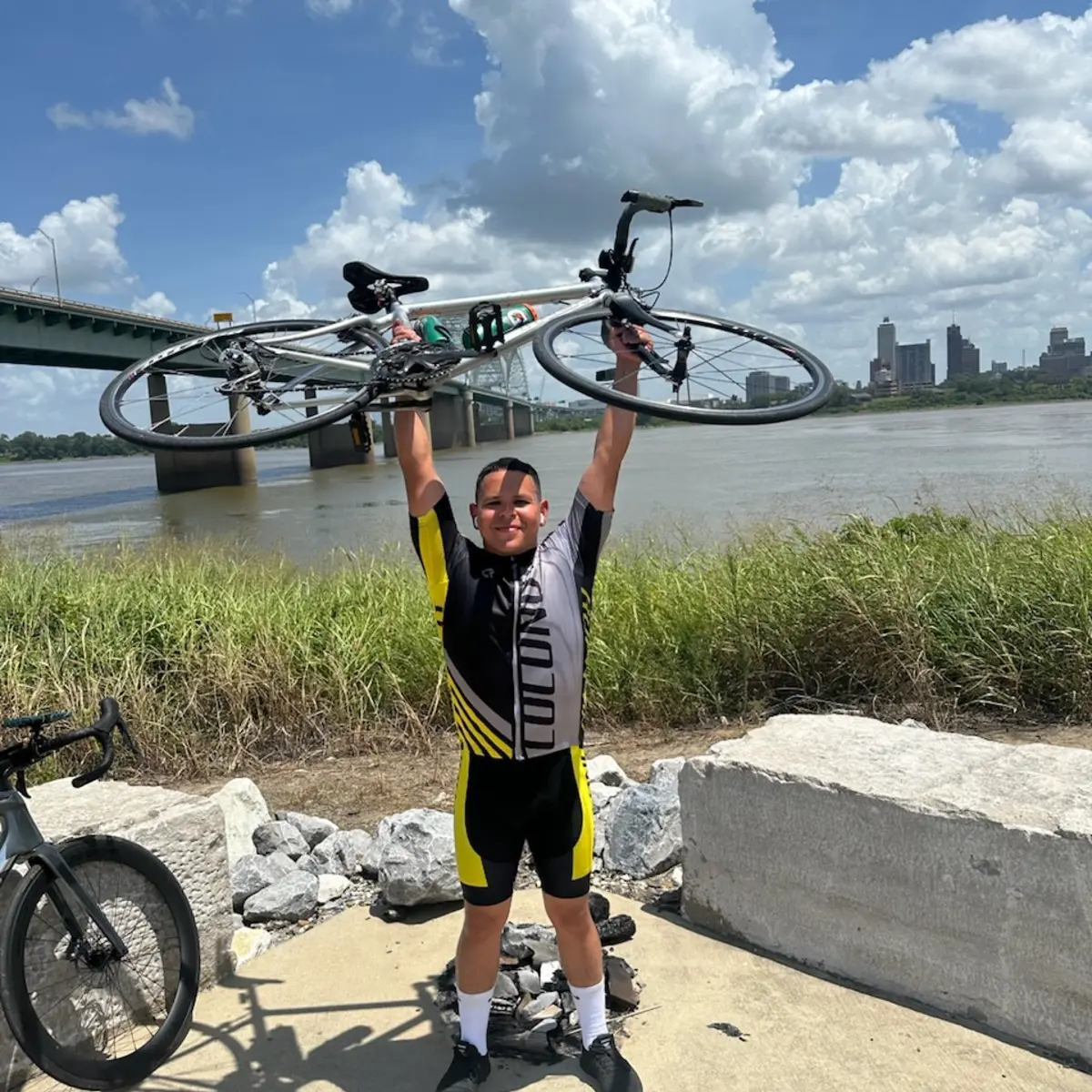
There is a photograph of him on the Memphis riverfront holding his road bike over his head, the Hernando de Soto Bridge and downtown behind him. Not long before that, the medical opinion was that he might not walk.
Who did the work
We want to be careful here, because it would be easy — and wrong — to write this as though a gym fixed a man.
When you climb a mountain, the sherpa shows you the route. Which way to go, what to bring, where not to put your foot. The sherpa carries knowledge of the mountain that you do not have, and that knowledge is worth a great deal. But the sherpa does not climb the mountain for you. You climb it. Every step is yours.
That is the arrangement here, with Alex and with everyone else who trains at Fit 901. We are the guide. We know the terrain, we have watched a lot of people cross it, and we will tell you where the loose rock is. Alex did the climbing. He turned up on the days it was hard — which, after a stroke, is most of them — and he kept turning up long enough for it to compound.
If you are reading this from a hospital bed, or from a couch
We are not going to tell you your recovery will look like Alex’s. It might not. Every stroke is different, every body is different, and anyone who promises you an outcome is selling something.
What we will tell you is that Alex started from a place where the professional expectation was that he would not get here, and the thing that moved him was ordinary, repeated work — with someone who knew what they were looking at standing next to him.
Talk to your doctor first. Then, if you want to know what the route would look like for you, book a free discovery call and we will have an honest conversation about it.
Alex reviewed this story and allowed us to share it. His two earlier updates are still here if you would like to read them: the original story and his 120-day update.