Why "Small Steps" Don't Always Work for Weight Loss
Key takeaways
Small steps fail when they're unstructured. Learn how specific, coached plans and medical support make weight loss actually stick.
Written by Rob Yahn
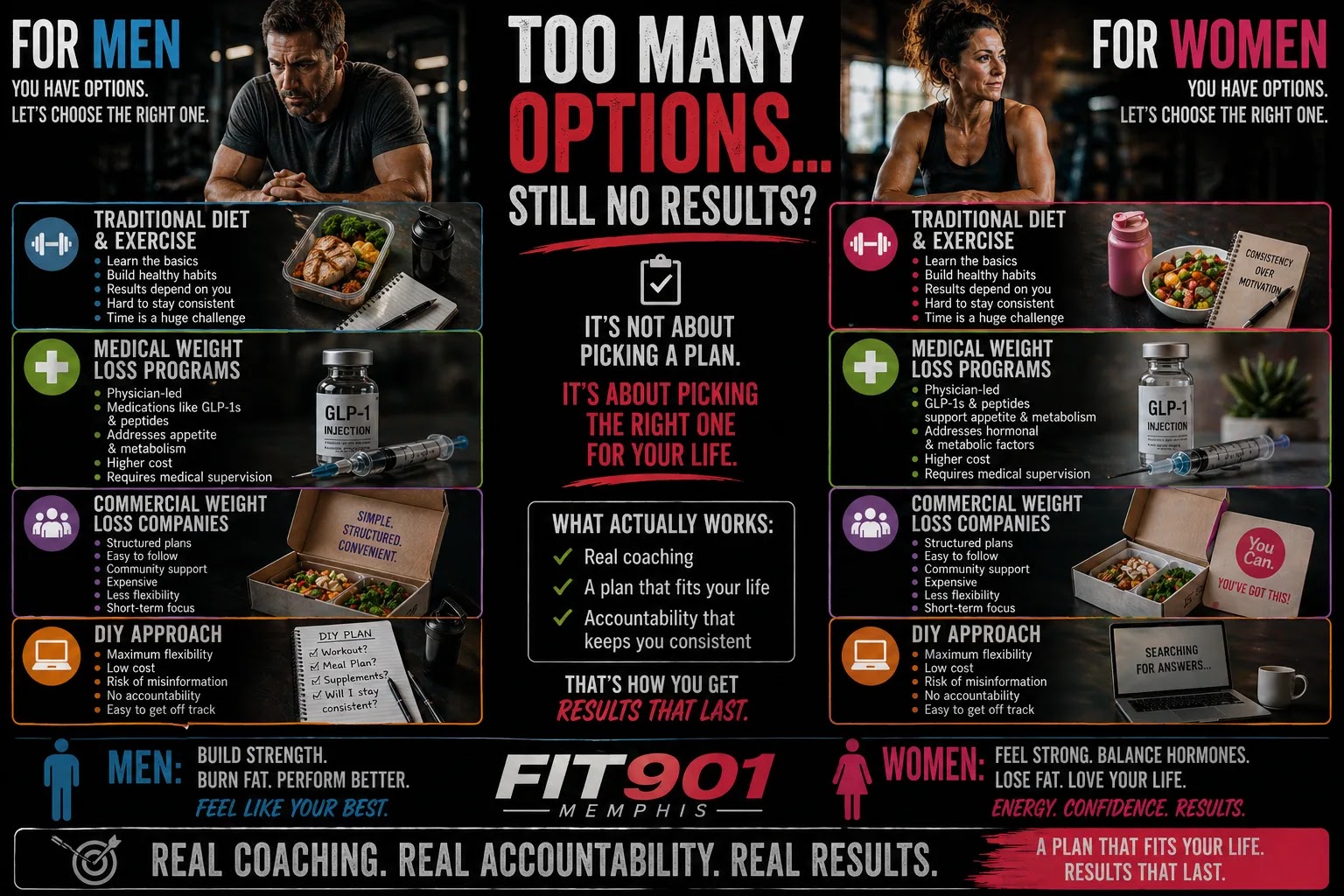
The honest answer is this: small steps only work for weight loss when they are the right small steps, attached to the right structure, and repeated consistently when motivation dips. The problem isn't the size of the step — it's the absence of a system that makes the next small step automatic. If you've ever tried "I'll just walk more" or "I'll cut out the late-night snacking" and still didn't see the results you wanted, you're not failing. You're likely under-structured.Key Takeaways
- Small changes are easier to start than drastic ones, but they fail without a clear target and tracking.
- Weight loss is largely a math problem — a deficit is required, not just intention.
- Adherence beats intensity: the best program is the one you'll actually stick to.
- Medical support (like GLP-1s or physician-led weight loss) can create the window for small steps to matter.
- Coaching bridges the gap between knowing what to do and doing it.
The first real answer to why "small steps" don't always work for weight loss comes down to this: weight loss is not a small-steps problem. It's a small-steps-plus problem. The steps have to be specific, measurable, and paired with an environment that supports them. Without that, "small" becomes vague, and vague gets ignored.
According to research on behavioral weight loss, even incremental, self-selected changes show meaningful improvement in affective state when they're part of a structured behavior change therapy (Paxman et al., 2011). The key word there is structured. Small steps work when there's a framework around them — not just good intentions.
Why Small Steps Alone Don't Move the Scale
Most people start with the best of intentions. They decide to drink more water, sleep an extra hour, add a short walk. And then life happens. The problem isn't the small step — it's the lack of accountability and the absence of a clear target. Weight loss requires a calorie deficit. Small steps like "eat less" or "move more" are too abstract to create that deficit reliably. You need to know what you're eating, how much you're eating, and how much activity you're burning. Without that data, you're guessing — and guessing rarely leads to consistent results.What the Research Says About Small Changes
The FIReWoRk trial on financial incentives for weight loss showed that goal-directed, outcome-based incentives can improve outcomes in low-income populations — but only when the goals are clear and the incentives are meaningful. Translation: small steps work better when they're tied to a specific outcome and a system of accountability. Another way to look at it: small steps are the vehicle, but the destination has to be defined. If you don't know how much weight you want to lose, or what your maintenance looks like, the small steps have no target to hit.What's Actually Wrong With the "Small Steps" Advice
The conventional advice to "just take small steps" assumes the reader has the baseline knowledge, the discipline, and the support system to execute. For many people — especially beginners, busy professionals, parents, and older adults — that's a lot of assumptions.- Knowledge isn't action: Knowing you should walk more doesn't mean you have a plan for when you're tired, busy, or unmotivated.
- Environment matters: If your pantry is full of snacks and your living room has a couch that calls your name, small steps need environmental design to work.
- Medical factors: Hormonal changes, stress, sleep deprivation, and metabolic conditions can all work against small steps without support.
How Structured Coaching Makes Small Steps Work
Here's the thing: small steps aren't the problem. Unstructured small steps are. When you have a coach who reviews your progress, adjusts your nutrition, and designs your strength training, the "small steps" become specific and measurable. For example, instead of "I'll eat healthier," it's "I'll hit 40g protein at breakfast, have a vegetable with lunch, and stop eating by 8pm." That's a small step. It's also actionable. Our coaches work with clients from their 20s to their 70s+, meeting each at their current level and building them to their best. Whether you're a busy professional, a first responder, a parent, or an older adult looking to age better, the approach is the same: real strength training, habit-based nutrition, and accountability for the 165 hours per week you're not in the gym. If you're someone who Googled "why small steps don't work for weight loss" at 11pm and didn't really want to say it out loud — you're not alone. The fear isn't about steps. It's about failing again, being judged, or not having the energy to do something big. The good news? You don't have to do something big. You just have to do something specific.Frequently Asked Questions
Why do small changes fail for weight loss?
Small changes fail when they're vague, unspecific, or unsupported. Without clear targets, tracking, and accountability, motivation fades. Research shows that structured behavior change therapy significantly outperforms unstructured willpower-based approaches.How long does it take for small steps to show results?
It varies, but initial changes in energy and mood can appear within weeks. Scale changes often take longer — typically 8-12 weeks of consistent deficit and strength training before noticeable fat loss.Can medical weight loss help me succeed with small steps?
Yes. Medical weight loss programs, including GLP-1 support under physician supervision, can create the calorie deficit needed for small steps to matter. At Fit 901, we combine this with coaching to ensure the changes stick.What's the first step I should take if I've tried small steps before?
Get specific. Write down your current intake, identify your activity level, and set one clear, measurable goal. Then get support to help you track and adjust.Is it too late for me to start small?
No. It's never too late. At any age, with the right guidance, small steps can create meaningful change. Our coaches work with adults 30-70+ who've seen results through strength training and lifestyle changes.About Fit 901
Fit 901 is a premium strength and lifestyle coaching company in Memphis, TN, specializing in personalized training, habit-based nutrition, and accountability for busy adults, athletes, first responders, and those 30-70+ seeking fat loss, muscle gain, mobility, and healthy aging. We specialize in helping busy professionals, parents, healthcare workers, military personnel, veterans, first responders, and older adults achieve sustainable results without extreme diets, intimidating gym culture, or unsafe workouts. Our approach combines strength training, athletic performance, healthy aging, tactical fitness, physician-led medical weight loss, peptide support, GLP-1 support, lifestyle and mindset coaching, and accountability. We teach systems and habits so clients do not have to rely on willpower or discipline alone. Our coaches meet each client at their current level and build them to their best. Whether you're coming in scared or coming in skeptical, you'll find a coach-led environment that scales to your ability.Ready to see if structured coaching is right for you? Book a free consult to talk to someone who actually listens.
Save 901-657-4552 to your contacts before we call — otherwise it will get screened as spam and we'll lose you.
--- ## About Fit 901 Fit 901 was founded by Rob Yahn, a Memphis firefighter-paramedic with Memphis Fire Department since 1996, and in the fire service since 1994. He served as Fire Lieutenant / Company Officer for 20+ years on Memphis's busiest truck companies. He is a USAW-certified coach and CrossFit L2 Trainer, and a KMG (Krav Maga Global) Instructor certified in Combat/Fight and Third Party Protection. Rob coaches clients from their 20s to 70s+, meeting each at their current level and building them to their best. His background in emergency response gives him real-world insight into injury prevention and human performance under stress. ---Ready for the next step?
Fit 901 · Memphis · 901-657-4552